Add one to the power, then divide by the new power — the exact reverse of differentiating.
The exclusion \( n \ne -1 \) exists because that case would divide by zero; \( \displaystyle\int
\dfrac{1}{x}\,\mathrm{d}x \) is not on Paper 1 and waits until
P2/3 5.
As with differentiation, rewrite before you integrate: \( \sqrt{x} = x^{1/2} \),
\( \dfrac{3}{x^{2}} = 3x^{-2} \), and divide through by a single-term denominator.
The constant of integration is not optional. Omitting \( +c \) on an indefinite
integral loses a mark every time it appears, and it is pure carelessness rather than
misunderstanding. When you are given a point on the curve, substitute it to find \(c\) and state
the particular equation — a question that says “find the equation of the curve”
is not answered until \(c\) is a number.
Reversing the chain rule
\[ \int (ax+b)^{n}\,\mathrm{d}x = \frac{(ax+b)^{\,n+1}}{a(n+1)} + c \]
Integrate as usual, then divide by the coefficient of \(x\). So
\( \displaystyle\int (3x+1)^{4}\,\mathrm{d}x = \dfrac{(3x+1)^{5}}{15} + c \). This works only when
the bracket is linear; for anything else you need the substitution methods of P2/3.
No constant of integration is needed, because it cancels. Set the working out with square
brackets and the limits, then substitute the top limit minus the bottom — in that order. When
the lower limit is negative, bracket the whole substitution: forgetting to distribute the minus sign
across it is the most common arithmetic error in this topic.
Areas
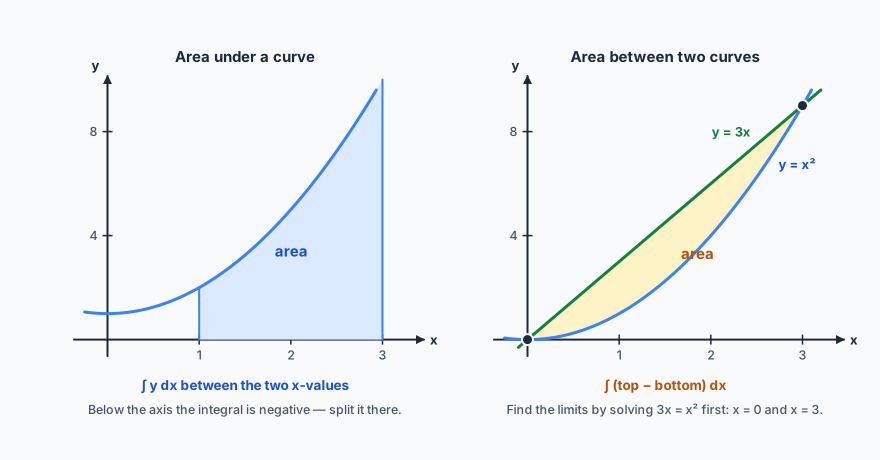
The area between the curve and the \(x\)-axis from \(a\) to \(b\) is
\( \displaystyle\int_a^b y\,\mathrm{d}x \), provided the curve stays above the axis.
Where the curve dips below, the integral returns a negative value for that
portion, and if you integrate straight through, the parts cancel and the answer is too small. For an
area, find where the curve crosses the axis, split the integral at each crossing, and add the
magnitudes.
For the area between two curves:
\[ A = \int_a^b \left(y_{\text{upper}} - y_{\text{lower}}\right)\mathrm{d}x \]
where \(a\) and \(b\) are the \(x\)-coordinates of the intersections. Subtracting first and
integrating once is both quicker and safer than integrating separately and subtracting, and it
handles regions below the axis automatically — provided you have identified which curve is on
top. Test a single \(x\)-value between the limits to be sure.
Area under a curve is \( \int y\,\mathrm{d}x \); area between two curves is \( \int (\text{top} - \text{bottom})\,\mathrm{d}x \) between their intersections.
Improper integrals
A definite integral is improper when one of its limits is infinite, or when the
integrand is undefined at one of the limits. Simple cases of both appear in 9709, and they are
handled the same way: integrate as usual, then consider what happens as the awkward limit is
approached.
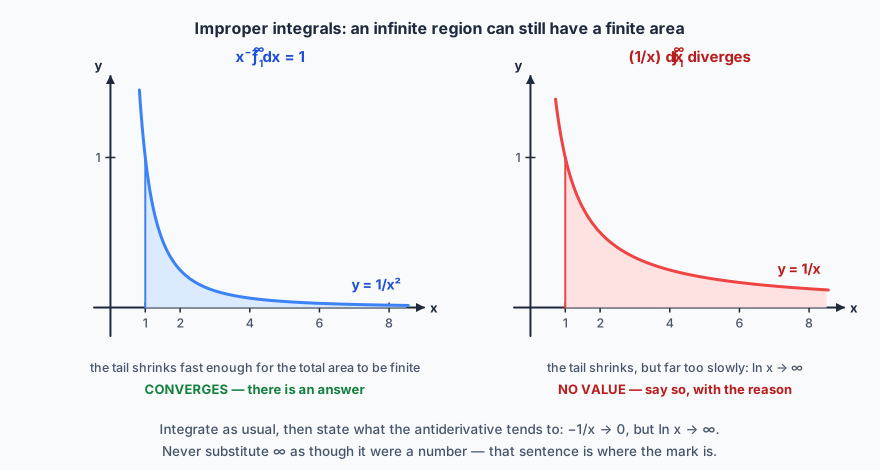
With an infinite upper limit, ask what the antiderivative tends to:
because \( \dfrac{1}{x} \to 0 \) as \( x \to \infty \). The area stretches out forever and still
totals 1 — the curve falls away fast enough for the tail to contribute almost nothing.
With an integrand undefined at the lower limit, the same idea applies at the other end:
Here \( x^{-1/2} \) shoots off to infinity as \( x \to 0 \), yet the antiderivative
\( 2\sqrt{x} \) is perfectly well behaved there, so the area is finite. An infinitely tall region
can have a finite area, just as an infinitely long one can.
Not every improper integral has a value. For \( \displaystyle\int_1^{\infty} \frac{1}{x}\,\mathrm{d}x \)
the antiderivative is \( \ln x \), and \( \ln x \to \infty \), so the integral does not
converge — there is no answer to give. Saying so, with the reason, is the answer.
Do not substitute \( \infty \) as though it were a number. Write the
antiderivative, then state what it tends to: “as \( x \to \infty \),
\( -\dfrac1x \to 0 \)”. That sentence is where the mark is. The same applies at a limit
where the integrand blows up — check the antiderivative is finite there, not the
integrand. Deciding convergence by looking at the integrand instead is the standard error, and it
gets \( \int_0^1 x^{-1/2}\,\mathrm{d}x \) wrong: the integrand is infinite at 0, the area is 2.
Two tails that look alike: \( \int_1^\infty x^{-2}\,\mathrm{d}x = 1 \) converges, \( \int_1^\infty x^{-1}\,\mathrm{d}x \) does not.
Volumes of revolution
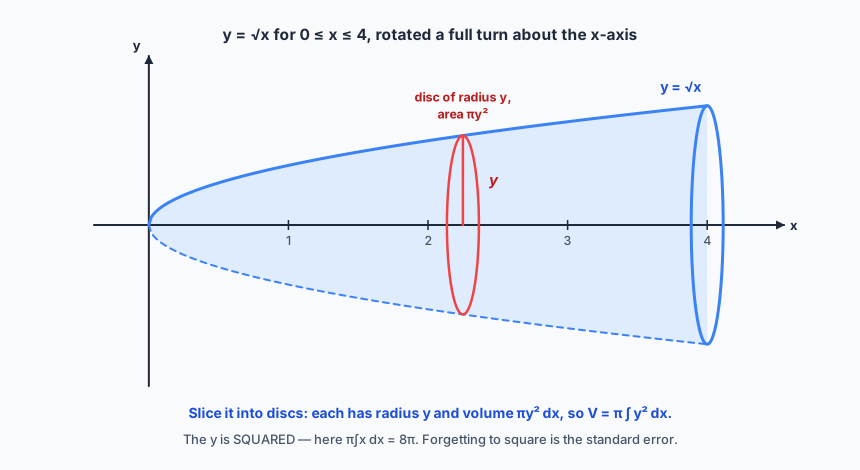
about the \(x\)-axis: \( V = \pi\displaystyle\int_a^b y^{2}\,\mathrm{d}x \)
about the \(y\)-axis: \( V = \pi\displaystyle\int_c^d x^{2}\,\mathrm{d}y \)
Three things to get right. It is \( y^{2} \), so square first, then integrate
— and squaring a bracket means expanding it, not squaring each term. For rotation about the
\(y\)-axis you must rearrange to get \( x^{2} \) in terms of \(y\), and the limits must be
\(y\)-values. And do not lose the \( \pi \); carrying it outside the integral throughout is the
tidiest way to keep it.
Rotating \( y = \sqrt{x} \) about the \(x\)-axis: each thin disc has area \( \pi y^{2} \), so \( V = \pi\int_0^4 x\,\mathrm{d}x = 8\pi \).
For a volume between two curves, subtract the volumes: \( \pi\displaystyle\int
\left(y_1^{2} - y_2^{2}\right)\mathrm{d}x \). Note that is the difference of the squares,
not the square of the difference.
✏️Worked example
(a) A curve passes through \( (2, 5) \) and has \( \dfrac{\mathrm{d}y}{\mathrm{d}x} = 3x^{2} - 4x \).
Find the equation of the curve.
(b) Find the area of the region enclosed by the curve \( y = 4x - x^{2} \) and the line
\( y = x \).
(c) The region bounded by \( y = \sqrt{x} \), the \(x\)-axis and the line \( x = 9 \) is rotated
completely about the \(x\)-axis. Find the volume generated, in terms of \( \pi \).
(a) Integrate: \( y = x^{3} - 2x^{2} + c \). Substitute the point:
\( 5 = 8 - 8 + c \), so \( c = 5 \) and
\[ y = x^{3} - 2x^{2} + 5 \]
(b) First find the intersections: \( 4x - x^{2} = x \) gives
\( 3x - x^{2} = 0 \), so \( x(3 - x) = 0 \) and \( x = 0 \) or \( x = 3 \).
Between those values the curve is above the line — test \( x = 1 \): curve gives 3, line
gives 1. So
Check it. In (b), the region is a lens shape roughly 3 wide and at most 2.25
tall (the maximum of \( 3x - x^{2} \) is at \( x = 1.5 \)), so an area of 4.5 is entirely
plausible — about two-thirds of the enclosing rectangle, which is what a parabolic segment
should be. In (c), the solid is close to a cone of radius 3 and height 9, whose volume would be
\( \tfrac{1}{3}\pi(9)(9) = 27\pi \); the true answer \( 40.5\pi \) is larger, as it should be,
since \( \sqrt{x} \) bulges outside the straight line.
Subtract before integrating, and square before integrating. In (b), integrating
the curve and the line separately and subtracting works but doubles the arithmetic and the chance
of a slip. In (c), \( \pi\displaystyle\int \sqrt{x}\,\mathrm{d}x \) — forgetting to square
\(y\) — gives \( 18\pi \) and is the single most common error in volumes of revolution. The
formula is \( \pi\displaystyle\int y^{2}\,\mathrm{d}x \), always.
📝Practise
Work through these, then reveal the answer. Each question targets a different objective from the list above.
Rewrite: \( 6x^{2} - 4x^{-3} + x^{1/2} \). Integrating term by term: \( \dfrac{6x^{3}}{3} - \dfrac{4x^{-2}}{-2} + \dfrac{x^{3/2}}{3/2} = 2x^{3} + 2x^{-2} + \tfrac{2}{3}x^{3/2} + c \). So the answer is \( 2x^{3} + \dfrac{2}{x^{2}} + \dfrac{2}{3}\sqrt{x^{3}} + c \). The middle term's double negative producing a plus is the step to watch.
Reverse the chain rule: raise the power to 4, divide by 4, then divide by the coefficient of \(x\), which is 4. So \( \dfrac{(4x-5)^{4}}{16} + c \). Checking by differentiating: \( \dfrac{4(4x-5)^{3} \times 4}{16} = (4x-5)^{3} \). ✓
4. Find the total area enclosed between the curve \( y = x^{3} - 4x \) and the \(x\)-axis.
Roots: \( x(x^{2} - 4) = 0 \) gives \( x = -2, 0, 2 \). The curve is above the axis on \( (-2, 0) \) and below on \( (0, 2) \), so integrate separately. \( \displaystyle\int_{-2}^{0}\left(x^{3}-4x\right)\mathrm{d}x = \left[\tfrac{x^{4}}{4} - 2x^{2}\right]_{-2}^{0} = 0 - (4 - 8) = 4 \). \( \displaystyle\int_{0}^{2}\left(x^{3}-4x\right)\mathrm{d}x = (4 - 8) - 0 = -4 \). Total area \( = 4 + |-4| = 8 \). Integrating straight from \( -2 \) to 2 would give 0, because the two halves cancel — the curve has rotational symmetry about the origin.
5. The region bounded by \( y = x^{2} + 1 \), the \(y\)-axis, and the lines \( y = 2 \) and \( y = 5 \) is rotated about the \(y\)-axis. Find the volume.
Rotation about the \(y\)-axis needs \( x^{2} \) in terms of \(y\): from \( y = x^{2} + 1 \), \( x^{2} = y - 1 \). The limits are already \(y\)-values. So \( V = \pi\displaystyle\int_{2}^{5}(y - 1)\,\mathrm{d}y = \pi\left[\tfrac{y^{2}}{2} - y\right]_{2}^{5} = \pi\left[\left(12.5 - 5\right) - \left(2 - 2\right)\right] = 7.5\pi \).
6. Find the area of the region enclosed by the curve \( y = x^{2} - 2x \) and the line \( y = 3 \).
Intersections: \( x^{2} - 2x = 3 \), so \( x^{2} - 2x - 3 = 0 \) and \( (x-3)(x+1) = 0 \), giving \( x = -1 \) and \( x = 3 \). Between these the line is above the curve (test \( x = 0 \): line 3, curve 0). So \( A = \displaystyle\int_{-1}^{3}\left[3 - \left(x^{2}-2x\right)\right]\mathrm{d}x = \displaystyle\int_{-1}^{3}\left(3 + 2x - x^{2}\right)\mathrm{d}x = \left[3x + x^{2} - \tfrac{x^{3}}{3}\right]_{-1}^{3} \). At 3: \( 9 + 9 - 9 = 9 \). At \( -1 \): \( -3 + 1 + \tfrac{1}{3} = -\tfrac{5}{3} \). So \( A = 9 + \tfrac{5}{3} = \tfrac{32}{3} \). Because upper minus lower was used, the answer is positive automatically.
🔗Go deeper — other people’s work
These are external resources, not mine. If one stops working, tell me and
everything above it on this page still stands.
3Blue1Brown — integration and the fundamental theorem of calculus
GeoGebra — rotate a region about an axis and see the solid appear
Desmos — shade the area between two curves and vary the limits